Thursday, February 9, 2023

place for entertainment

Entertainment places are establishments that offer leisure activities for people looking to have fun, relax, or experience something new. 

Here are some examples of entertainment places: Movie theaters: Offer a place to watch the latest films on the big screen. 

 Amusement parks: 

Provide a variety of fun activities such as roller coasters, ferris wheels, and other thrill rides. Arcades: Feature classic and modern video games, air hockey, and other interactive activities. 

 Bowling alleys: 

Offer a fun way to spend time with friends and family while enjoying a game of bowling. Concert venues: Host live music performances by popular artists and bands.  

 Theaters: 

Offer stage performances of plays, musicals, and other shows.

 Museums: 

Provide educational and entertaining experiences through exhibitions of art, science, history, and more.  

 Aquariums: 

Offer visitors the opportunity to observe marine life up close. 

 Escape rooms: 

Offer a fun, challenging experience where participants solve puzzles and complete tasks to escape a themed room. 

 Sports arenas: 

Host live sporting events, including basketball, hockey, and football games 

These are just a few examples of the many types of entertainment places available.


visit here

roofing companies in bullhead city az 

 stucco contractors bullhead city az

roofers in bullhead city az

roofing companies bullhead city 

bullhead city roofing contractors

 roofing contractors bullhead city az 


Sunday, August 14, 2022

An explanation of Progressive Web Apps for the non-PWA crowd

 The universe of uses was arranged into two classifications not very far in the past. You were either making an application for Android gadgets or for iOS. Enter PWAs, or lengthened, Progressive Web Applications. You have likely been hearing about them for the recent years, yet close to a pleasant abbreviation, you have no clue about what a PWA is. As their prevalence builds, it very well may be really smart to get to understand what's going on with all the fight.


In this article, I'll take you on a visit through what a PWA is, which parts it is worked from, and show you how you can make one all alone.


The Basics

A dynamic web application is a site transformed into an application. This means, rather than coding either in Java or Objective-C (or later portable coding dialects), you can compose the code for the application, similar to you would for a site. You have your html records, your templates, and your contents.


How could you fabricate a PWA rather than a local application? First of all, envision that once you discharge a PWA, you can transform it continually without republishing your application. Since everything the code is facilitated on a server and not piece of the APK/IPA, any change you make occurs continuously.


Assuming you have at any point utilized an application that depends on an organization association, you are know about the dissatisfaction of not having the option to do anything. With PWAs, you can offer a disconnected encounter to your clients in the event of organization issues.


Also, to include the cherry top, there is a capacity to provoke the client to add your PWA to their home screen. Something that local applications don't have.


Parts

There is a standard in regards to a PWA, and you should stick to it to distribute one. Each PWA is worked from the accompanying parts:


A web application manifest

A help laborer

Introduce insight

HTTPS

Making an APK

Beacon review

The Manifest

This is simply a design record (.JSON), empowering you to change different settings of your PWA and how it will appear to the client. The following is an illustration of one:


manifest.json

You should set either a name/short name key. While setting both, short name will be utilized on the home screen and the launcher. The name worth will be utilized in the Add to Home Screen insight (or, application introduce brief).


Show can have four distinct qualities:


fullscreen - this permits your application to take up the entire screen when it is opened

independent - your application seems to be a local application, concealing program components

negligible ui - gives some perusing controls (just upheld for Chrome versatile)

program - like the name says your application's look will be indistinguishable from a perusing experience

You can likewise set the direction of your application and the extent of the pages viewed as inside your application.


Remember to add the manifest to your primary html document by putting the accompanying meta label within your head tag:


Photograph by sol on Unsplash

The Service Worker

A help specialist is a part running behind the scenes of your site on the program. It has a wide arrangement of functionalities including, pop-up messages, storing resources and giving them to a disconnected encounter and the capacity to concede activities until the client has a steady association with the web. A help laborer can be an entire Medium article all alone, so I will not dive into the inward subtleties of how it functions. Yet, I will supply a vanilla illustration of one for you to use in your PWA.


It is standard to save the code connected with the help laborer in a document called sw.js.


✋ The area of the help specialist is significant since it can get to records that are in a similar registry or subdirectory as itself.


A help specialist has a lifecycle that can be summarized to the accompanying stages:


Enrollment

Establishment/Activation

Answering different occasions


Focus on the remarks to comprehend where to put the various lines of code

Introduce Experience

One of the extraordinary elements of a PWA is its introduce insight. What this means is inciting the client to introduce your application. To permit us to introduce this capacity to the client, we should tune in on an occasion called before install prompt. The following is a code test exhibiting the stream from giving the client the choice to add the application to initiating rationale in light of their decision.


Introduce Experience Flow


Photograph by James Sutton on Unsplash

HTTPS

Not very far in the past, sites might in any case utilize the really quite normal http convention. Because of late changes in security and in Chrome, all sites that don't work under the https convention will be set apart as not got. Regardless of whether your site handle client information or delicate correspondence, it is still great practice to switch over to https.


Furthermore, similar to I referenced before, if you need to have the option to deliver a PWA, it needs to utilize the https convention. To get into the issue of procuring a space, finding a legitimate host for itself and afterward empowering SSL, you can go for the simple choice of Git hub. In the event that you have a record, you can open a vault and set up a GitHub Page. This cycle is genuinely basic and direct and the reward is getting the HTTPS worked in as a feature of Git hub.


Making An APK

For our PWA to be accessible inside the Google Play Store, we want to make an APK. You can utilize the well known device, PWA2APK, which will accomplish the difficult work for you. Yet, assuming you like to figure out how to do it without anyone else's help, continue to peruse.


Google has acquainted another way with coordinate your PWA into the Play store utilizing what is known as a Trusted Web Activity, or TWA. With only a couple of straightforward advances you will figure out how to make a TWA, which you can then transfer to the Play store.


Open Android Studio and make a vacant movement

Go to the undertaking's build.gradle record and add the jitpack vault


3. Go to the module level build.gradle record and add the accompanying lines to empower Java8 similarity


4. Add the TWA support library as a reliance


5. Add the action XML inside your AndroidManifest document between the application labels


Supplant the android:value and android:host with your URL

6. We really want to make a relationship from the application to the site utilizing a computerized resources connect. Glue the accompanying inside your strings.xml document


Change the site worth to highlight your URL

7. Add the following meta tag as a youngster to your application label inside the AndroidManifest.xml


8. Make a transfer key and key store


9. Utilize the accompanying order to remove the SHA-256


Recollect the subtleties you entered while creating a keystore and your transfer key

10. Go to the resources connect generator, supply the SHA-256 unique mark, the bundle of your application and the site's area


11. Place the outcome in a document named assetlinks.json under the area/.notable in your site's catalog. Chrome will search for this objective explicitly.


12. Produce a marked APK and transfer to the Play store


Photograph by Aaron Burden on Unsplash

Beacon

At this point, I am certain you have proactively forgotten about what is expected from your PWA so it will substantial for distribute. There are such countless things to think about, that it is not difficult to forget about what the prerequisites are.


Fortunately for us, Google has made Lighthouse. It tends to be found in the Chrome Developer Tools (from Chrome variant 60). It very well may be gotten to effectively by right-clicking inside the program and choosing examine. At the point when the new sheet opens, you will see an Audits tab at the extreme right corner.


The Audits Tab

Leaving the settings in this tab as they are, you can now run a review by tapping on the "Run reviews" button. This will require a little while, yet toward its finish, you will get a useful, graphical show of where your PWA positions in regard to three properties:


Execution

Availability

Best Practices

Every property has a breakdown of where your application passed the necessities and where it didn't. This allows you to see where you want to make changes and where you are fulfilling the guideline. In the event that you are intrigued, you can track down a breakdown of the agenda here.


PWA it up

We are at our process' end and ideally you are feeling improved ready to explore the universe of PWAs. This article was motivated by the cycle I went through while making one as of late. You can look at it underneath:


Android Menu XML Generator - Apps on Google Play

Produce any sort of menu you want for your Android application. Look over an Options, Context or Popup menu and…

Saturday, August 13, 2022

How to find the index where a number belongs in an array in JavaScript

 Photo by Claudel Rhea ult on Un sprinkle


Orchestrating is an essential thought while making estimations. There are a large number of sorts: bubble sort, shell sort, block sort, brush sort, blended drink sort, mythical person sort — I'm not making these up!


This challenge gives us a short investigate the grand universe of sorts. We really want to sort various numbers from least to generally critical and find out where a given number would have a spot in that display.


Estimation rules


Return the most diminished record at which a value (second conflict) should be installed into a group (first dispute) at whatever point it has been organized. The returned worth should be a number.


For example, getIndexToIns([1,2,3,4], 1.5) should return 1because it is more significant than 1 (document 0), yet under 2 (record 1).


Also, getIndexToIns([20,3,5], 19) should return 2because once the show has been organized it will look like [3,5,20] and 19 is under 20 (document 2) and more critical than 5 (record 1).


Assuming Test Cases


get Index To Ins([10, 20, 30, 40, 50], 35) should bring 3 back.


get Index To Ins([10, 20, 30, 40, 50], 35) should return a number.


get Index To Ins([10, 20, 30, 40, 50], 30) should bring 2 back.


get Index To Ins([10, 20, 30, 40, 50], 30) should return a number.


get Index To Ins([40, 60], 50) should bring 1 back.


get Index To Ins([40, 60], 50) should return a number.


get Index To Ins([3, 10, 5], 3) should bring 0 back.


get Index To Ins([3, 10, 5], 3) should return a number.


get Index To Ins([5, 3, 20, 3], 5) should bring 2 back.


get Index To Ins([5, 3, 20, 3], 5) should return a number.


get Index To Ins([2, 20, 10], 19) should bring 2 back.


get Index To Ins([2, 20, 10], 19) should return a number.


get Index To Ins([2, 5, 10], 15) should bring 3 back.


get Index To Ins([2, 5, 10], 15) should return a number.


get Index To Ins([], 1) should bring 0 back.


get Index To Ins([], 1) should return a number.


Course of action #1: .sort( ), .record Of( )


PEDAC


Getting a handle on the Problem: We have two data sources, a display, and a number. We need to return the rundown of our input number after it is organized into the data display.


Models/Test Cases: The extraordinary people at free Code Camp don't tell us in what heading the data display should be organized, yet the gave tests explain that the information group should be organized from least to generally conspicuous.


Notice that there is an edge case on the last two gave tests where the data bunch is an empty show.


Data Structure: Since we're ultimately returning a document, remaining with bunches will work for us.


We will utilize a cunning strategy named .record Of():


.record Of() profits the principal document at which a part is accessible in a display, or a - 1 if the part is missing in any capacity. For example:


let food = ['pizza', 'frozen yogurt', 'chips', 'frankfurter', 'cake']


food. list Of('chips')


// brings 2 back


food .list Of('spaghetti')


// returns - 1


We're moreover going to use .concat () here as opposed to .push(). Why? Since when you add a part to a group using .push (), it returns the length of the new display. Right when you add a part to a bunch using .concat (), it returns the new display itself. For example:


let group = [4, 10, 20, 37, 45]


cluster .push(98)


// brings 6 back


cluster. con feline (98)


// returns [4, 10, 20, 37, 45, 98]


Estimation:


Install num into arr.


Sort arr from least to generally unmistakable.


Return the record of num.


Code: See under!


Without adjacent factors and comments:


Plan #2: .sort( ), .track down Index ( )


PEDAC


Sorting out the Problem: We have two information sources, a show, and a number. We need to return the record of our criticism number after it is organized into the data display.


Models/Test Cases: The extraordinary people at free Code Camp don't tell us in what heading the data bunch should be organized, but the gave tests explain that the data display should be organized from least to generally conspicuous.


There are two edge cases to consider with this game plan:


If the data bunch is unfilled, we truly need to return 0 considering the way that num would be the principal part in that show, in this way at record 0.


If num would have a spot toward the completion of arr organized from least to generally imperative, then, we need to return the length of arr.


Data Structure: Since we're finally returning a record, remaining with shows will work for us.


We should checkout .track down Index() to figure out how it's ending up assisting with handling this test:


.track down Index() returns the record of the vital part in the display that satisfies the gave testing ability. Anyway, it returns - 1, exhibiting no part completed the evaluation. For example:


let numbers = [3, 17, 94, 15, 20]


numbers .track down Index ((current Num ) => current Num % 2 == 0)


// brings 2 back


numbers. track down Index((current Num) => current Num > 100)


// returns - 1


This is significant, taking everything into account because we can use .track down Index() to balance our criticism num with each number in our input arr and figure out where it would fit all together from least to generally essential.


Estimation:


Expecting that arr is an unfilled show, bring 0 back.


In the event that num has a spot close to the completion of the organized show, return the length of arr.


Anyway, return the document num would be if arr was organized from least to generally critical.


Code: See under!


Without adjacent factors and comments:


If you have various game plans and also thoughts, compassionately offer in the comments!


This article is a piece of the series free Code Camp Algorithm Scripting.


This article references free Code Camp Basic Algorithm Scripting: Where do I Belong.


You can follow me on Medium, LinkedIn, and GitHub!

Friday, August 12, 2022

Deep-dive into Spark internals and architecture


Apache Spark is an open-source distributed general-purpose cluster-computing framework. A spark application is a JVM process that’s running a user code using the spark as a 3rd party library.

As part of this blog, I will be showing the way Spark works on Yarn architecture with an example and the various underlying background processes that are involved such as:

  • Spark Context
  • Yarn Resource Manager, Application Master & launching of executors (containers).
  • Setting up environment variables, job resources.
  • Coarse Grained Executor Backend & Netty-based RPC.
  • Spark Listeners.
  • Execution of a job (Logical plan, Physical plan).
  • Spark-WebUI.

Spark Context

Spark context is the first level of entry point and the heart of any spark application. Spark-shell is nothing but a Scala-based REPL with spark binaries which will create an object sc called spark context.

We can launch the spark shell as shown below:

spark-shell --master yarn \
--conf spark.ui.port=12345 \
--num-executors 3 \
--executor-cores 2 \
--executor-memory 500M

As part of the spark-shell, we have mentioned the num executors. They indicate the number of worker nodes to be used and the number of cores for each of these worker nodes to execute tasks in parallel.

Or you can launch spark shell using the default configuration.

spark-shell --master yarn

The configurations are present as part of spark-env.sh

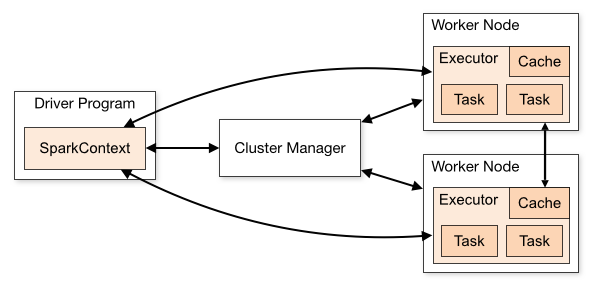
Our Driver program is executed on the Gateway node which is nothing but a spark-shell. It will create a spark context and launch an application.

The spark context object can be accessed using sc.

After the Spark context is created it waits for the resources. Once the resources are available, Spark context sets up internal services and establishes a connection to a Spark execution environment.

Yarn Resource Manager, Application Master & launching of executors (containers).

Once the Spark context is created it will check with the Cluster Manager and launch the Application Master i.e, launches a container and registers signal handlers.

Once the Application Master is started it establishes a connection with the Driver.

Next, the Application Master End Point triggers a proxy application to connect to the resource manager.

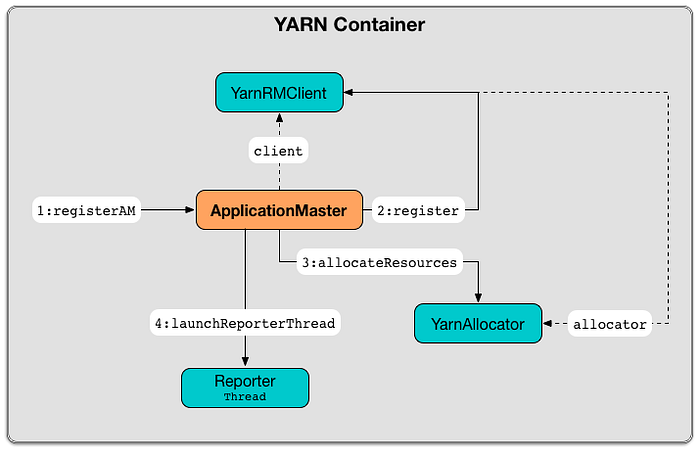
Now, the Yarn Container will perform the below operations as shown in the diagram.


ii) Yarn RM Client will register with the Application Master.

iii) Yarn Allocator: Will request 3 executor containers, each with 2 cores and 884 MB memory including 384 MB overhead

iv) AM starts the Reporter Thread

Now the Yarn Allocator receives tokens from Driver to launch the Executor nodes and start the containers.

Setting up environment variables, job resources & launching containers.

Every time a container is launched it does the following 3 things in each of these.

  • Setting up env variables

Spark Runtime Environment (Spark Env) is the runtime environment with Spark’s services that are used to interact with each other in order to establish a distributed computing platform for a Spark application.

  • Setting up job resources

YARN executor launch context assigns each executor with an executor id to identify the corresponding executor (via Spark WebUI) and starts a Coarse Grained Executor Backend.

Coarse Grained  Executor Backend & Netty-based RPC.

After obtaining resources from Resource Manager, we will see the executor starting up

Coarse Grained Executor Backend is an Executor Backend that controls the lifecycle of a single executor. It sends the executor’s status to the driver.

When Executor Runnable is started, Coarse Grained Executor Backend registers the Executor RPC endpoint and signal handlers to communicate with the driver (i.e. with Coarse Grained Scheduler RPC endpoint) and to inform that it is ready to launch tasks.

Netty-based RPC - It is used to communicate between worker nodes, spark context, executors.

Netty RPC End Point is used to track the result status of the worker node.

Rpc Endpoint Address is the logical address for an endpoint registered to an RPC Environment, with Rpc Address and name.

It is in the format as shown below:

This is the first moment when Coarse Grained Executor Backend initiates communication with the driver available at driver Url through RpcEnv.

Spark Listeners


Spark Listener (Scheduler listener) is a class that listens to execution events from Spark’s DAG Scheduler and logs all the event information of an application such as the executor, driver allocation details along with jobs, stages, and tasks and other environment properties changes.

Spark Context starts the Live Listener Bus that resides inside the driver. It registers Job Progress Listener with Live Listener Bus which collects all the data to show the statistics in spark UI.

By default, only the listener for Web UI would be enabled but if we want to add any other listeners then we can use spark. extra Listeners.

Spark comes with two listeners that showcase most of the activities

i) Stats Report Listener

ii) Event Logging Listener

Event Logging Listener: If you want to analyze further the performance of your applications beyond what is available as part of the Spark history server then you can process the event log data. Spark Event Log records info on processed jobs/stages/tasks. It can be enabled as shown below...

The event log file can be read as shown below

  • The Spark driver logs into job workload/perf metrics in the spark. even Log. dir directory as JSON files.
  • There is one file per application, the file names contain the application id (therefore including a timestamp) application_1540458187951_38909.

It shows the type of events and the number of entries for each.

Now, let’s add Stats Report Listener to the spark. extra Listeners and check the status of the job.

Enable INFO logging level for org. apache. spark. scheduler. Stats Report Listener logger to see Spark events.

To enable the listener, you register it to Spark Context. It can be done in two ways.

i) Using Spark Context. add Spark Listener(listener: Spark Listener) method inside your Spark application.

Click on the link to implement custom listeners - Custom Listener

ii) Using the conf command-line option

Let’s read a sample file and perform a count operation to see the Stats Report Listener.

Execution of a job (Logical plan, Physical plan).

In Spark, RDD (resilient distributed dataset) is the first level of the abstraction layer. It is a collection of elements partitioned across the nodes of the cluster that can be operated on in parallel. RDDs can be created in 2 ways.

i) Parallelizing an existing collection in your driver program

ii) Referencing a dataset in an external storage system

RDDs are created either by using a file in the Hadoop file system, or an existing Scala collection in the driver program, and transforming it.

Let’s take a sample snippet as shown below

The execution of the above snippet takes place in 2 phases.

6.1 Logical Plan: In this phase, an RDD is created using a set of transformations, It keeps track of those transformations in the driver program by building a computing chain (a series of RDD)as a Graph of transformations to produce one RDD called a Lineage Graph.

Transformations can further be divided into 2 types

  • Narrow transformation: A pipeline of operations that can be executed as one stage and does not require the data to be shuffled across the partitions — for example, Map, filter, etc..

Now the data will be read into the driver using the broadcast variable.

  • Wide transformation: Here each operation requires the data to be shuffled, henceforth for each wide transformation a new stage will be created — for example, reduce By Key, etc..

We can view the lineage graph by using to Debug String

6.2 Physical Plan: In this phase, once we trigger an action on the RDD, The DAG Scheduler looks at RDD lineage and comes up with the best execution plan with stages and tasks together with Task Scheduler Impl and execute the job into a set of tasks parallelly.

Once we perform an action operation, the Spark Context triggers a job and registers the RDD until the first stage (i.e, before any wide transformations) as part of the DAG Scheduler.

Now before moving onto the next stage (Wide transformations), it will check if there are any partition data that is to be shuffled and if it has any missing parent operation results on which it depends, if any such stage is missing then it re-executes that part of the operation by making use of the DAG( Directed Acyclic Graph) which makes it Fault tolerant.

In the case of missing tasks, it assigns tasks to executors.

Each task is assigned to Coarse Grained Executor Backend of the executor.

It gets the block info from the Name node.

now, it performs the computation and returns the result.

Next, the DAG Scheduler looks for the newly runnable stages and triggers the next stage (reduce By Key) operation.

The Shuffle Block Fetch erIterator gets the blocks to be shuffled.

Now the reduce operation is divided into 2 tasks and executed.

On completion of each task, the executor returns the result back to the driver.

Once the Job is finished the result is displayed.

Spark - Web UI

Spark-UI helps in understanding the code execution flow and the time taken to complete a particular job. The visualization helps in finding out any underlying problems that take place during the execution and optimizing the spark application further.

We will see the Spark-UI visualization as part of the previous step 6.

Once the job is completed you can see the job details such as the number of stages, the number of tasks that were scheduled during the job execution of a Job.

On clicking the completed jobs we can view the DAG visualization i.e, the different wide and narrow transformations as part of it.

You can see the execution time taken by each stage.

On clicking on a Particular stage as part of the job, it will show the complete details as to where the data blocks are residing, data size, the executor used, memory utilized and the time taken to complete a particular task. It also shows the number of shuffles that take place.

Further, we can click on the Executors tab to view the Executor and driver used.

Now that we have seen how Spark works internally, you can determine the flow of execution by making use of Spark UI, logs and tweaking the Spark Event Listeners to determine optimal solution on the submission of a Spark job.

Note: The commands that were executed related to this post are added as part of my GIT  account.

Similarly, you can also read more here:

  • Sqoop Architecture in Depth with code.
  • HDFS Architecture in Depth with code.
  • Hive Architecture in Depth with code.

If you would like too, you can connect with me on LinkedIn —Jayvardhan Reddy. 

If you enjoyed reading it, you can click the clap and let others know about it. If you would like me to add anything else, please feel free to leave a response

place for entertainment

Entertainment places are establishments that offer leisure activities for people looking to have fun, relax, or experience something new.  H...